
Boutique Property Investment & Advisory
We combine market insights with financial analysis to unlock value in UK real estate.
Get Access to Our UK Property Investment Insights & Opportunities.
About Festa & Co
At Festa & Co, we bring together chartered accountancy expertise and hands on development experience. By combining rigorous financial analysis with deep property market insight, we uncover value-add opportunities and design strategies that deliver measurable returns.
Our services span deal sourcing, investment analysis, project management, and partnerships - always guided by clarity, confidence, and precision. We work with a select group of investors and property owners who share our values of transparency and long-term partnership.
Our Services

Advisory & Consulting
Data driven deal analysis, market insights and project appraisals to support decision making.
Independent analysis, yield & ROI modelling, and market research for clarity and confidence.
From comparable and sensitivities to exit scenarios - we translate numbers into strategy

Capital & Partnerships
Structured private capital solutions - from fixed-return loans to joint ventures and uplift profit share.
We align incentives through private loans and JVs, partnering on planning, refurb, and exits.
Bespoke capital structures that support deposits, value-add works, and development execution.

Project Management
End-to-end oversight: acquisition, refurb, and disposal—on time, on budget, on brief.
Trusted delivery from scope and contractor selection to quality control and exit preparation.
We manage value-add works with financial discipline and transparent reporting.
Insights & Analysis
Our insights combine market research, investor-focused updates, and real deal analysis. From tax and regulatory changes to on-the-ground market trends, we provide clarity for those investing in UK property. Explore our latest articles and case studies - including featured deal breakdowns with supporting analysis.
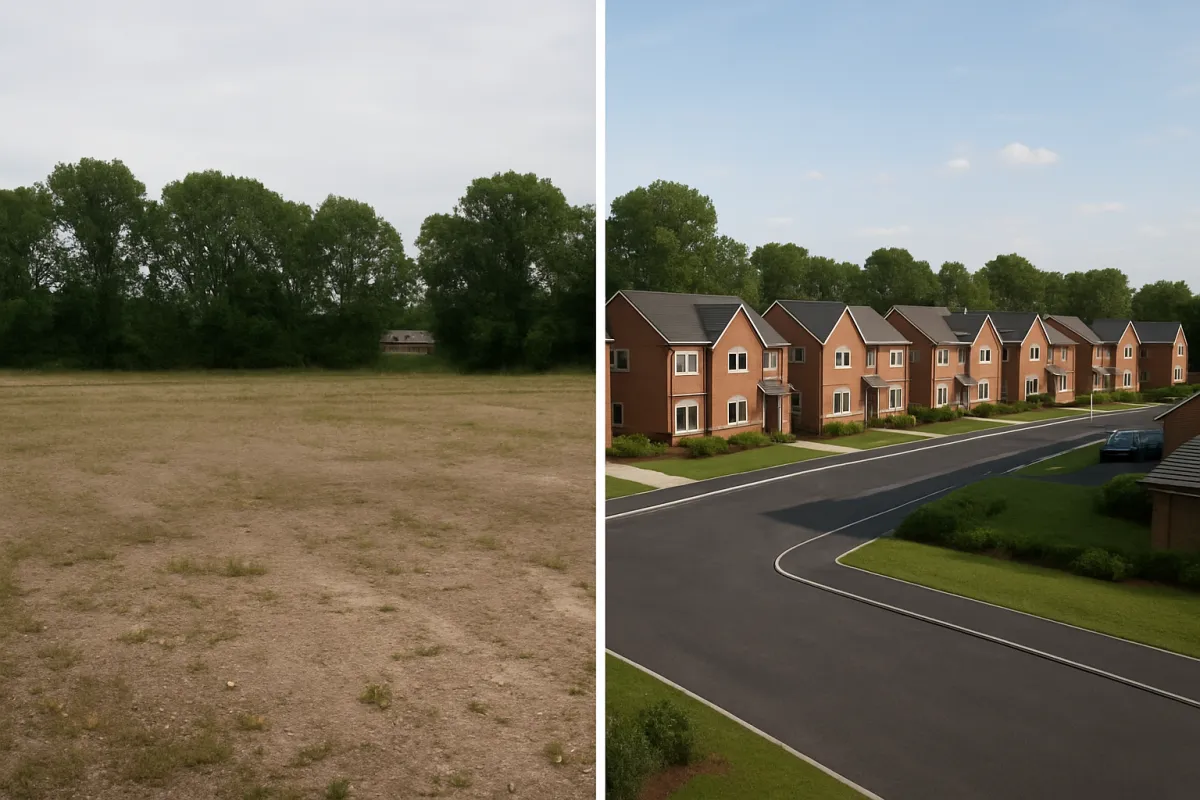
Planning Gain on Land: What Landowners Need To Know
Planning Gain & Land Value: What Landowners Need to Know
If you own land in or around London, Essex or the wider South East, you may already suspect your plot has more value than it appears. Often, that extra value comes from planning permission. What many landowners don’t realise is how much planning policy — both national and local — affects uplift in value, and how certain types of sites are more likely to benefit than others.

What is Planning Gain?
Planning gain refers to the increase in value your land can achieve once planning permission (or a favourable allocation in a Local Plan) is secured. Without permission, land may be worth only a fraction of its true potential. With permission, it can often command two to three times more.
For landowners, the difference between selling without exploring planning potential and selling with permissions or allocations in place can mean hundreds of thousands — even millions — of pounds.
National Policy: What the NPPF Says
The National Planning Policy Framework (NPPF) is the government’s main planning document (latest update: December 2024). Key points landowners should know:
Presumption in favour of sustainable development (Paragraph 11): where councils cannot demonstrate a five-year housing land supply, the “tilted balance” applies, making it easier to secure permission.
Making effective use of land: brownfield sites and land near existing services are preferred for housing delivery (NPPF paras 119–125).
Green Belt protection: remains strong(paras 152–154), but exceptions exist for limited infilling, redevelopment of previously developed sites, or where “very special circumstances” can be proven.
Grey Belt (new in 2024): the NPPF now recognises that some parts of the Green Belt do not strongly contribute to its purposes, or are previously developed. These areas — dubbed “Grey Belt” — may be treated more flexibly, particularly where housing need is acute, provided strict conditions (“Golden Rules”) on affordable housing, infrastructure, and design are met.
Developer obligations: affordable housing, Section 106 agreements, and Community Infrastructure Levy (CIL) payments are central to how value is shared between landowners, developers, and councils.
Types of Sites & Their Planning Potential
Different land types carry very different prospects for planning permission and, therefore, value uplift:
Allocated Land — already earmarked in a Local Plan for development; usually strong prospects of planning being granted, subject to design and obligations.
Brownfield Land — previously developed; favoured under NPPF’s “make effective use of land” guidance.
Infill Plots — small gaps within built-up areas; often acceptable if access and design are suitable.
Green Belt — tightly controlled; development rare except in exceptional cases(UK Gov guidance).
Grey Belt — new category; land technically in the Green Belt but either previously developed or not strongly serving Green Belt purposes. Grey Belt could present new opportunities for landowners if councils are under pressure to meet housing need (UK Gov Flowchart).
Key Planning Considerations
Even if your land type looks favourable, planning applications can be refused unless certain considerations are addressed:
Access & Highways — safe, practical entry and exit for vehicles, plus adequate parking and traffic management.
Design & Character — does the scheme fit its surroundings in scale, height, and style?
Environmental Constraints — flood risk, contamination, protected trees or habitats, heritage assets.
Neighbour Impact — privacy, overlooking, daylight, and noise can all lead to objections.
The Financial Side: Developer Obligations
Planning permission is valuable, but it comes with financial obligations that reduce the “headline” value of land. These include:
Affordable Housing: typically required above a certain unit threshold (often 10+ units in London and the South East).
Community Infrastructure Levy (CIL): fixed charge per square metre, varying by borough.
Section 106 Agreements: bespoke contributions for highways, schools, green space, or commuted sums.
For example, a 12-unit scheme in London might trigger a 35% affordable housing requirement plus CIL, cutting into what a developer can pay for the land — but still much higher than the unallocated value (Greater London Authority Framework).
Likelihood of Success by Site Type
Allocated Land: High chance, though obligations and delivery tests apply.
Brownfield Land: Good chance, especially in areas with housing shortages.
Infill Sites: Moderate chance, highly dependent on access and neighbour impact.
Green Belt: Low chance unless “very special circumstances.”
Grey Belt: New territory. Early signs suggest councils under housing pressure may release Grey Belt parcels, provided the site is sustainable, design is sensitive, and extra obligations are delivered (Urban Architeture Case Reviews).
Examples in London & Essex
Essex: £3.6m of government funding is being used to unlock brownfield sites for 200+ new homes, showing how surplus or under-used land is being prioritised (Essex County Council Brownfield Funding).
Chelmsford: Draft Local Plan updates propose new strategic growth sites, with allocations boosting land values significantly (Chelmsford City Council).
Takeley (Uttlesford): A recent proposal for 96 homes shows how larger schemes in sustainable locations are coming forward with infrastructure and open space commitments (Planning Application Redetermination).
What Landowners Should Do
If you own land and are considering selling, here are practical steps:
Check the Local Plan: Is your site allocated, or could it fall under Grey Belt in future revisions?
Assess Constraints: Flood risk, access, or heritage issues could block development.
Understand Obligations: Factor in affordable housing and infrastructure costs.
Consider Options: A direct sale may not capture all the uplift. Option agreements or promoting land through the Local Plan may unlock higher value.
Get Expert Advice Early: Festa & Co can help assess scenarios, model valuations, and guide negotiations.
Conclusion
Planning gain can transform the value of land — but only if you understand how the system works. Allocations, permissions, obligations, and now even Grey Belt policy all shape outcomes.
For landowners in London, Essex and the wider South East, the opportunity is real — but so are the risks of selling too soon or too cheaply.
👉 If you’re thinking of selling land, speak to Festa & Co first. Our independent analysis helps you understand your land’s true potential and make confident, informed decisions.

Request a Private Consultation
Festa & Co works with a select group of investors, property owners, and partners. Complete the form below to apply for an appointment, and a member of our team will be in touch. Or email:

Apply to join our investor list or request a consultation. All requests are reviewed individually, and consultations are arranged by appointment only.

Festa & Co - Bridging insight, capital and opportunity.
© 2026 Festa & Co. All rights reserved.
Festa & Co. is a trading name of Sky Vista Property Solutions Ltd, a company incorporated in England and Wales under company number 15854023, with its registered office at 52 Collins Meadow, Harlow, England, CM19 4EW.
All content is for information purposes only and does not constitute financial advice.